What this document is, how to get it and how to read it before buying property
Nota Simple in Spain is one of the key documents when buying property. For a foreign buyer, it is the first legal filter that helps understand who the registered owner of the property is, which rights are registered over it and whether there is a mortgage, seizure, easement, restriction or other encumbrance.
Buying an apartment, house, villa, flat or commercial premises in Spain should not start only with viewing photos, negotiating the price and signing a reservation. Before paying a serious deposit, it is necessary to request a Nota Simple and check the property in the Registro de la Propiedad.
But it is important to understand: Nota Simple is not full legal due diligence and not a guarantee of transaction safety. It is an informational extract from the registry. It shows important data, but it does not replace a lawyer’s analysis, Catastro check, comunidad debts, IBI, urbanismo, licences, tenants, tourist rental restrictions and the actual condition of the property.
The main conclusion: Nota Simple is a mandatory document before buying property in Spain, but it is not enough simply to obtain it. It must be read correctly and compared with other documents.
Key Takeaways on Nota Simple in Spain
Nota Simple is an informational extract from the Registro de la Propiedad for a specific property. It shows the registered legal picture of the property: property identification, owner or owners, registered rights and possible encumbrances.
In the Nota Simple, you can see who the owner is, whether there is a mortgage, seizure, embargo, easement, usufructo, disposal restriction, registered third-party rights or other entries that may affect the transaction.
For the buyer, Nota Simple is especially important before signing the contrato de arras. If the document shows a mortgage, seizure, several owners, a third-party right of use or inconsistency in the property description, this must be clarified before paying the deposit.
At the same time, Nota Simple is informational. It is not a public document that officially certifies the content of the registry. For that kind of confirmation, a certificación registral signed by the registrar is used.
In practice, this means that Nota Simple is suitable for initial checks and transaction analysis, but in disputed, complex or court-related situations, a certificación registral may be required.
What Is a Nota Simple?
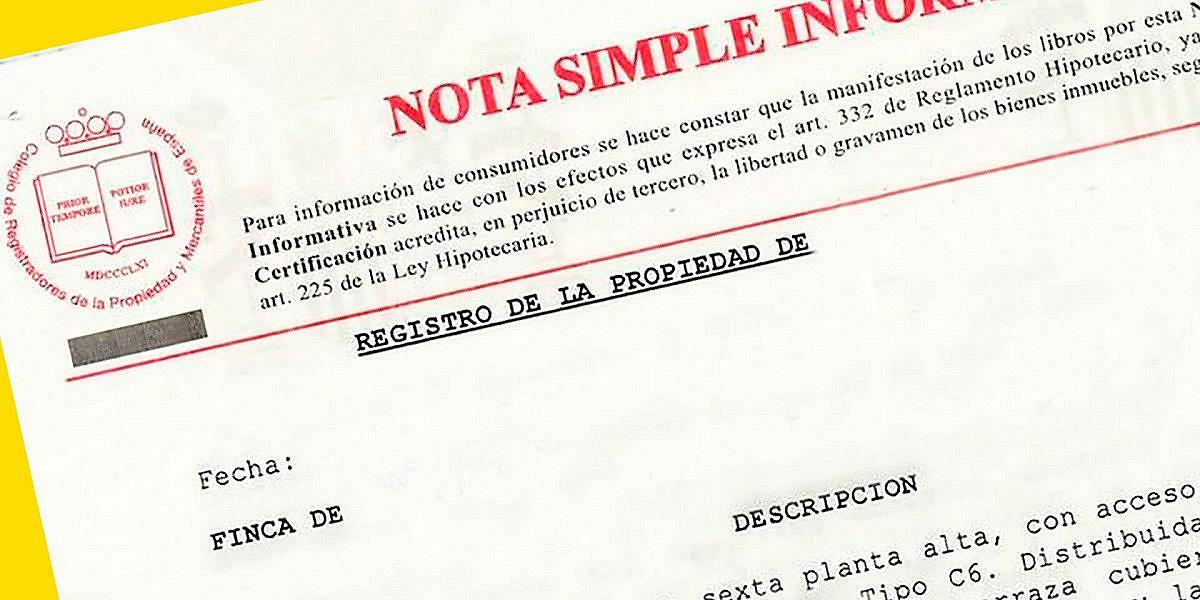
Nota Simple Informativa is a short informational extract from the Registro de la Propiedad. It relates to a specific finca registral, meaning a property registered in the land registry.
It can be requested by the buyer, lawyer, bank, agency, owner or another person if there is a legitimate interest.
In the context of buying property, Nota Simple is needed to understand:
whether the property exists in the Registro de la Propiedad;
who the registered owner is;
whether the seller has the right to sell the property;
whether there is a mortgage;
whether there are seizures or embargo;
whether there are easements;
whether there are restrictions;
whether there is usufructo or other third-party rights;
whether the property description matches the actual condition;
whether there is information requiring additional checks.
Nota Simple is the starting point of legal due diligence, but not its final stage.
Where to Get a Nota Simple
A Nota Simple can be requested through the Registro de la Propiedad or through the online service of the Colegio de Registradores.
In practice, it is most often obtained by the buyer’s lawyer, an agency or the buyer through the official Registradores de España website. It is also possible to go in person to the Registro de la Propiedad if it is known in which registry the property is registered.
The request may require:
property address;
owner details;
finca registral;
CRU or IDUFIR;
cadastral reference;
Registro de la Propiedad details;
other information that allows the property to be identified.
It is best to request Nota Simple by finca registral or CRU, because addresses in Spain may be written differently and do not always allow the property to be found accurately.
If the buyer is not sure what exactly to request, it is better to entrust this to a lawyer. An identification error may result in obtaining a Nota Simple for the wrong property.
When to Request a Nota Simple
Nota Simple should be requested before signing financially binding documents.
The ideal order is the following:
the buyer chooses a property;
Nota Simple is requested;
the lawyer checks the owner, description and encumbrances;
additional documents are checked;
only after that, a reservation or contrato de arras is signed with protective conditions.
In practice, a property may leave the market quickly, and the agency may suggest paying a reservation first. In this case, the reservation document must include refund conditions if legal due diligence reveals problems.
If the buyer signs a contrato de arras without checking the Nota Simple, they may find themselves in a weak position. For example, it may later turn out that the property is not being sold by the only owner, or that there is a seizure, mortgage, usufructo or other restriction.
Who Can Request a Nota Simple?
A Nota Simple can be requested by a person who has a legitimate interest. In the context of buying property, such interest may be the intention to buy the property, check the legal situation, assess transaction risk or prepare a mortgage.
Usually, Nota Simple is requested by:
buyer;
buyer’s lawyer;
real estate agency;
bank;
mortgage broker;
owner;
notary;
valuer;
investor.
When requesting the document, it is usually necessary to state the reason: purchase, legal due diligence, mortgage, rental, investment analysis or another legitimate interest.
What a Nota Simple Shows
A Nota Simple usually contains several important sections.
Registro de la Propiedad data
At the beginning of the document, it states which registry issued the extract, the date of issue and the property registration data.
Property identification
It indicates the finca registral, CRU or IDUFIR, address, property description, area, sometimes the share in common elements of the building and the cadastral reference if it is linked to the registry entry.
Property description
The document may state whether the property is an apartment, house, garage, storage room, plot, commercial premises or another type of real estate.
Owner
It indicates the registered owner or owners, their shares, type of ownership right and sometimes the acquisition basis.
Rights and restrictions
It may show mortgage, usufructo, servidumbre, embargo, seizures, disposal prohibitions, conditions, restrictions or other registered rights.
Encumbrances
This is one of the most important sections. It shows whether there are registered cargas that may affect the transaction.
Entries requiring analysis
The document may mention previous mortgage entries, tax restrictions, easements, urbanismo, development conditions or other elements requiring legal interpretation.
How to Read a Nota Simple
A Nota Simple should be read not as a formality, but as the legal map of the property.
First question: is this the right property?
It is necessary to check the address, finca registral, CRU, cadastral reference, floor, door, area, parking space, storage room and description. If the buyer is viewing an apartment with parking and a storage room, it is necessary to understand whether they are included in one finca or registered separately.
Second question: who is the owner?
The seller’s name must match the registered owner. If there are several owners, all of them must sign the transaction or grant authority to a representative. If the property belongs to a company, the powers of the director or representative must be checked.
Third question: are there encumbrances?
Mortgage, embargo, usufructo, servidumbre or disposal prohibition may seriously affect the transaction. Some encumbrances can be removed before the notary or simultaneously with the transaction. Others may make the purchase risky.
Fourth question: does the property match reality?
If the Nota Simple shows 70 m² while the advertisement shows 95 m², the reason must be understood. It may be a terrace, common elements, an unregistered extension, an advertising error or a registration issue.
Fifth question: are there hidden issues for additional checks?
Nota Simple may not give a full answer, but it may show direction: urbanismo, easements, restrictions, old mortgages, third-party rights or inconsistencies in the description.
Finca Registral
Finca registral is the registered property unit in the Registro de la Propiedad. It is not the same as the cadastral reference.
One apartment, one parking space, one storage room or one plot may be separate fincas registrales. Sometimes the apartment and parking space are separate properties, sometimes they are linked elements.
When buying, it is important to understand:
which finca is being sold;
whether there is a separate finca for parking;
whether there is a separate finca for the storage room;
whether all properties are included in the price;
whether all of them will be transferred at the notary;
whether each property has encumbrances;
whether the data matches the contract.
An error with finca registral may lead to the buyer purchasing the apartment but not the parking space or storage room they believed was included.
CRU and IDUFIR
CRU means Código Registral Único. Previously, the term IDUFIR was often used. It is the unique registration code of the property in the Registro de la Propiedad system.
CRU helps identify the property precisely in the registry.
For the buyer, CRU is important because addresses may change or be written differently, while CRU makes it possible to link the Nota Simple clearly to a specific property.
When checking a transaction, the lawyer should compare CRU, finca registral, address, cadastral reference and seller documents.
Referencia Catastral
Referencia catastral is the cadastral reference of the property in Catastro.
It does not replace finca registral and is not the same as CRU. Catastro and Registro perform different functions.
Catastro is important for taxes, IBI, area, cadastral value, reference value and administrative identification of the property.
Registro is important for ownership rights and registered rights.
A Nota Simple may include the referencia catastral, but it must additionally be checked through Catastro and compared with the IBI receipt, actual property and Registro data.
If the cadastral reference is missing or does not match, this does not always make the purchase impossible, but it requires analysis.
Owner in the Nota Simple
The owner section is one of the most important.
It is necessary to check:
who the owner is;
whether there is one owner or several;
what share each owner holds;
whether all owners are selling;
whether there is a spouse whose consent is needed;
whether the property belongs to a company;
whether the representative has authority;
whether the property is registered to heirs;
whether the property is in dispute.
If the seller does not match the owner in the Nota Simple, the transaction cannot be considered safe without explanation and documents.
For example, an agent may say that the owner’s son is selling the property. But if the son is not the owner and does not have a power of attorney, he cannot sell it.
If there are several owners, the signature of only one of them is not enough.
Ownership Shares
A Nota Simple may show that the property belongs to several people in different shares.
For example:
one owner holds 50%;
the second owner holds 50%;
one person holds usufructo and another holds bare ownership;
the property belongs to heirs in different shares.
The buyer must make sure that all persons whose rights are affected participate in the transaction.
Special attention must be paid to inheritance situations, divorces, family property, properties with usufructo and real estate owned by companies.
Usufructo
Usufructo is the right to use a property. In real estate, it may mean that one person is the owner, but another person has the right to use the property.
For the buyer, this is critically important.
If the property is sold with registered usufructo, the new owner may receive ownership rights but will not be able to freely use the property until the usufructo ends or is removed.
Therefore, if usufructo exists, it is necessary to understand:
who has the right of use;
for what term;
whether this right can be removed;
whether the usufructuario participates in the transaction;
which documents are needed;
how it affects the price;
whether a mortgage can be obtained.
Buying a property with usufructo without legal analysis is dangerous.
Hipoteca
Hipoteca means mortgage. If the Nota Simple shows the seller’s mortgage, this is not always a problem. Many properties are sold with a mortgage that is closed on the day of the notarial transaction.
But the process must be organised correctly.
It is necessary to check:
seller’s bank;
outstanding debt;
debt certificate;
amount to be repaid at the notary;
who receives the bank cheque;
who pays for mortgage cancellation;
when the mortgage will be removed from the Registro;
whether this is reflected in the escritura.
The buyer should not simply transfer the full amount to the seller if there is a mortgage on the property. Part of the price may be paid directly to the seller’s bank to repay the loan.
If the mortgage is not cancelled correctly, it may continue to appear as an encumbrance in the Registro.
Embargo and Seizures
Embargo is a seizure or enforcement entry registered over the property.
It may be linked to the seller’s debts, tax claims, court decisions, bank debts or other obligations.
If there is an embargo in the Nota Simple, it is necessary to clarify:
who imposed the seizure;
for what amount;
whether the seizure can be removed;
which documents are needed;
whether it will be removed before the transaction;
which part of the price will be used to repay the debt;
whether there is a risk of other claims.
Buying a property with embargo may be possible, but only with proper legal support. Without checking, it is a high risk.
Servidumbre
Servidumbre means easement. It is a limited right of use over a property or plot by third parties.
For example, it may be:
right of way;
right of vehicle access;
access to utilities;
construction restriction;
right to use part of the plot;
engineering networks;
obligations in favour of a neighbouring plot.
For an apartment, an easement may be less noticeable, but for a villa, house or plot it may be very important.
If the Nota Simple shows servidumbre, it is necessary to understand how it affects use of the property, privacy, construction, renovation, access, fencing and future sale.
Cargas
Cargas are encumbrances or registered restrictions over the property.
Cargas may include:
mortgage;
seizure;
easement;
usufructo;
usage conditions;
disposal prohibition;
tax restrictions;
third-party rights;
urbanismo;
other registered entries.
The cargas section must not be ignored. Even if the agent says that “it is old and irrelevant”, the lawyer must check every entry.
Sometimes old entries remain in the Nota Simple even though they are no longer practically relevant, but they have not been removed from the registry. Before buying, it is necessary to understand whether they must be cancelled and who pays for it.
What Nota Simple Does Not Show
Nota Simple is important, but it does not show all risks.
It usually does not give a full answer to the following questions:
whether there are comunidad debts;
whether there are IBI debts;
whether there are utility debts;
whether there are illegal layout changes;
whether the actual area matches the documents;
whether there are urbanismo issues;
whether tourist rental is permitted;
whether there is a prohibition in the comunidad;
whether there are tenants;
whether there are verbal agreements;
what the technical condition of the property is;
whether there is damp, cracks or building problems;
whether special comunidad contributions are planned;
whether there are court conflicts inside the building;
what the real market price is;
what the tax base is;
whether a mortgage can be obtained.
Therefore, Nota Simple is only part of due diligence.
Nota Simple and Catastro
After obtaining the Nota Simple, it must be compared with Catastro.
The following are compared:
address;
cadastral reference;
area;
use;
property plan;
plot;
buildings;
year of construction;
IBI data;
reference value, if applicable.
Discrepancies between Registro and Catastro are quite common. They are not always a critical problem, but they must be understood before purchase.
For example, Registro may show an apartment as 80 m², Catastro as 92 m² and the advertisement as 100 m². Reasons may differ: common areas, terraces, errors, changes or unregistered works.
The buyer must not simply know the numbers, but understand the legal consequences of the discrepancies.
Nota Simple and IBI
The IBI receipt helps additionally check the property.
IBI usually shows:
municipality;
cadastral reference;
tax amount;
owner or taxpayer;
taxable property;
cadastral value;
address.
Comparing Nota Simple, Catastro and IBI helps identify inconsistencies.
Before buying, the latest IBI receipt and confirmation that there are no debts must be requested. Nota Simple by itself does not guarantee absence of IBI debts.
Nota Simple and Comunidad
Nota Simple does not replace a comunidad check.
Even if there are no encumbrances in the Registro, the seller may have debts to the owners’ community. The comunidad may also have approved special contributions, court disputes, prohibitions on tourist rental or major repairs.
Before buying, it is necessary to request:
certificate of no comunidad debts;
monthly payment amount;
minutes of recent meetings;
comunidad statutes;
house rules;
information on special contributions;
decisions on tourist rental;
planned works.
Sometimes a property is legally clean in the Registro but financially problematic because of the condition of the comunidad.
Nota Simple and Tourist Rental
Nota Simple usually does not give a full answer to whether the property can be rented to tourists.
For tourist rental, it is additionally necessary to check:
regional rules;
municipal restrictions;
existence of licence;
possibility of obtaining a licence;
comunidad rules;
building statutes;
owners’ meeting decisions;
technical requirements;
registration number, if needed;
right to advertise the property on platforms.
If the buyer purchases an apartment for short-term rental, it is not enough to rely on Nota Simple. Tourist regulation and building documents must be checked separately.
Nota Simple When Buying an Apartment
When buying an apartment, Nota Simple helps check:
owner;
area;
floor;
apartment description;
share in common elements;
mortgage;
seizures;
easements;
registered restrictions;
parking and storage room, if included.
Special attention must be paid to parking and storage rooms. They may be:
part of the same finca;
separate fincas;
rights of use;
not included in the sale;
not registered as a separate property.
If the buyer believes parking is included in the price, this must be confirmed by documents.
Nota Simple When Buying a Villa
When buying a villa, Nota Simple is especially important, but not sufficient.
It helps check:
owner;
plot;
house area;
registered buildings;
mortgage;
easements;
restrictions;
boundaries;
legal status of the finca;
possible encumbrances.
But a villa requires additional checks of urbanismo, Catastro, actual buildings, swimming pool, garage, extensions, guest house, fence, access, utilities and licences.
A common issue is that the actual house is larger than registered. For example, the Nota Simple shows 150 m², but in reality there are 230 m² with a swimming pool and additional room. This requires analysis.
Nota Simple When Buying a New-Build Property
When buying a new-build property, Nota Simple can be used to check the land, developer, project and future registration of the property.
If the property is already built and registered, a Nota Simple can be obtained for the specific apartment.
If the project is under construction, the check is more complex. It is necessary to analyse:
developer’s right to the land;
registry data of the plot;
obra nueva;
división horizontal;
building licence;
bank guarantees;
contract;
first occupancy licence;
registration of each unit after completion.
For a new-build, Nota Simple is only one of the documents. Comprehensive checks of the developer, licences and guarantees are more important.
Nota Simple for a Mortgage
The bank almost always requires Nota Simple during mortgage analysis.
The bank uses it to check:
owner;
property;
encumbrances;
seller’s mortgage;
seizures;
registry data;
whether the property can be accepted as collateral.
But it is important to understand: the bank’s check protects the bank, not the buyer fully. Even if the bank is ready to finance the property, the buyer needs an independent lawyer.
The bank may accept the property as collateral, but it may not analyse all issues related to rental, urbanismo, comunidad, future liquidity or tax strategy.
Nota Simple and Contrato de Arras
Before signing the contrato de arras, the Nota Simple must be checked.
The arras contract must correctly state:
property details;
finca registral;
cadastral reference;
owner;
price;
notary deadline;
encumbrance status;
obligation to remove mortgage or debts;
parking and storage room;
furniture and equipment;
tenants;
legal due diligence conditions;
mortgage condition if the buyer depends on bank financing.
If the Nota Simple shows a mortgage, this must be reflected in the arras: how and when it will be repaid.
If there are several owners, all must participate.
If there are encumbrances, it must be written that the property is transferred free from them, if that is a condition of the transaction.
Nota Simple and the Notarial Transaction
Before the notary, the Nota Simple is usually updated to make sure that no new encumbrances have appeared during transaction preparation.
This is especially important if several weeks or months pass between signing arras and the notarial transaction.
During this time, theoretically, the following may appear:
new seizure;
disposal prohibition;
change in mortgage entry;
another registry entry;
change of owner;
court restrictions.
Therefore, the lawyer must check that the Nota Simple is up to date closer to the transaction date.
Nota Simple and Certificación Registral
Nota Simple and certificación registral are different documents.
Nota Simple
It is informational. It is convenient for initial checks, purchase, property analysis and transaction preparation.
Certificación registral
This is an official public document signed by the registrar that certifies the content of the Registro de la Propiedad.
Certificación may be needed in more serious situations: court matters, disputes, official confirmation of rights, complex transactions, inheritance, conflict-related encumbrances or when a document with evidentiary force is required.
For most standard purchases, Nota Simple is used as the basic document, but in complex risk situations the lawyer may request certificación.
How Long Is a Nota Simple Valid?
Nota Simple has no universal validity period in the sense that it is a snapshot of information at the moment of issue.
The older the document, the less practical value it has.
For buying property, it is advisable to use a fresh Nota Simple. If the document is several weeks or months old, it must be updated before signing arras or the notarial transaction.
The practical principle: Nota Simple should be up to date at the key stages of the transaction — before arras and before the notary.
Can a Nota Simple Be Wrong?
Nota Simple reflects information from the Registro de la Propiedad, but the buyer must consider several points.
It is informational.
It may not show unregistered facts.
It may contain old entries that are no longer practically relevant but have not been removed.
It may contain a description that does not match the actual condition of the property.
It does not replace Catastro, IBI, comunidad, urbanismo and technical inspection.
Therefore, Nota Simple alone should not be the only basis for buying.
Red Flags in a Nota Simple
The buyer should be cautious if the Nota Simple shows:
seller does not match the owner;
several owners, but only one person signs;
registered usufructo;
embargo;
disposal prohibition;
mortgage without a clear removal mechanism;
easements affecting use;
area strongly differs from the advertisement;
parking is not listed although promised;
storage room is not listed although included in the price;
property is described differently from its actual use;
old cargas;
unclear entries;
no link with Catastro;
property belongs to a company without checking authority;
signs of inheritance or court situation.
A red flag does not always mean that the purchase is impossible. But it means that the buyer must stop and clarify the issue before paying.
Main Buyer Mistakes
The most common mistake is not requesting Nota Simple before reservation or arras.
The second mistake is obtaining the document but not understanding its content.
The third mistake is looking only at the owner’s name and ignoring cargas.
The fourth mistake is not checking the seller’s mortgage.
The fifth mistake is overlooking usufructo or easement.
The sixth mistake is not comparing the area with Catastro and the actual property.
The seventh mistake is thinking that Nota Simple shows comunidad debts.
The eighth mistake is thinking that Nota Simple confirms tourist rental possibility.
The ninth mistake is using an old Nota Simple.
The tenth mistake is considering Nota Simple a complete legal guarantee.
The main principle: Nota Simple must be read together with a lawyer and other documents.
What to Check Together with Nota Simple
For a safe purchase, it is necessary to request and check not only Nota Simple.
Additionally, the following are needed:
Catastro;
IBI receipt;
certificate of no comunidad debts;
minutes of comunidad meetings;
comunidad statutes and house rules;
seller documents;
power of attorney, if there is a representative;
debt certificate for the seller’s mortgage;
rental contract, if there is a tenant;
energy certificate;
licences and urbanismo for a house or villa;
first occupancy licence, if applicable;
new-build documents;
bank guarantees for off-plan purchases;
rental possibility check;
tax calculation;
contrato de arras.
Only a comprehensive check gives the buyer a real understanding of risk.
How to Safely Use Nota Simple When Buying
The correct order of working with Nota Simple is as follows.
First, the buyer chooses a property.
Then a fresh Nota Simple is requested.
The lawyer checks the owner, finca, CRU, description and cargas.
Then the document is compared with Catastro, IBI and the actual condition of the property.
If there is a mortgage, seizure or other encumbrance, the removal mechanism is agreed.
If there are area discrepancies, they are analysed.
If the property is bought with parking or storage room, their registration status is checked.
If the property is bought for rental, licences and comunidad rules are checked additionally.
If the purchase depends on a mortgage, Nota Simple is sent to the bank.
Before the notary, the Nota Simple is updated.
After the transaction, ownership is registered in the buyer’s name.
FAQ
What is Nota Simple in Spain?
Nota Simple is an informational extract from the Registro de la Propiedad for a specific property. It shows the property identification, owner and registered rights or encumbrances.
Why do you need Nota Simple when buying property?
It is needed to check who the owner is, whether there is a mortgage, seizures, easements, usufructo, restrictions or other registered risks.
Where can you get a Nota Simple?
A Nota Simple can be requested through the Registro de la Propiedad or online through the Colegio de Registradores. Usually, the buyer’s lawyer does this.
Can you buy property without a Nota Simple?
Technically, the transaction may move forward, but it is extremely risky. Without Nota Simple, the buyer does not see the basic registration situation of the property.
Does Nota Simple show comunidad debts?
Usually, no. Comunidad debts must be checked separately through a certificate from the owners’ community or administrator.
Does Nota Simple show IBI debts?
No. For this, IBI receipts and municipal data must be checked. Nota Simple does not replace tax due diligence.
Does Nota Simple show tourist rental possibility?
Usually, no. Tourist rental must be checked separately: regional rules, municipal restrictions, licencia turística, registration number and comunidad rules.
What should you do if there is a mortgage in the Nota Simple?
It is necessary to check the outstanding debt and the mortgage cancellation mechanism. Usually, the seller’s mortgage is repaid and cancelled on the transaction day or before it.
How is Nota Simple different from certificación registral?
Nota Simple is informational. Certificación registral is an official document signed by the registrar that certifies the content of the Registro de la Propiedad.
What is the main buyer mistake?
The main mistake is signing arras and paying a deposit without checking a fresh Nota Simple and without analysing encumbrances, owner, area and additional documents.
Rusol Prime — Expert in Checking Property in Spain
Rusol Prime helps foreign buyers safely buy property in Spain: request and analyse Nota Simple, check the owner, encumbrances, mortgage, seizures, Catastro, IBI, comunidad, urbanismo, rental possibility and tax consequences.
We analyse not only the price and location, but also the legal clarity of the property, finca registral, CRU, Registro de la Propiedad, cadastral data, third-party rights, arras contract, mortgage, new-builds, villas, tourist rental and exit strategy.
Get a personal consultation with Rusol Prime — we will check the Nota Simple and other documents for a property in Spain before purchase, identify risks and help you complete the transaction safely: for living, holidays, rental income, investment or capital preservation.